 On
Our Knees with Clapton
On
Our Knees with Clapton Sermon by the Rev. Andrew S. Rollins
June 1, 2008 (Proper 4A)
Text: Romans 3:21 – 25a, 28
Title: “On Our Knees with Clapton”
For there is no distinction, since all have sinned and fall short of the glory of God.
The False Distinctions We Make
I want to tell you a true story about an experience I had one afternoon several years ago in New Orleans. I was driving down St. Charles Avenue on my way to a lunch appointment in the French Quarter. I was wearing a dark suit and collar. The window was rolled up and AC blasting because it was extremely hot outside. A light turned red and I stopped at the intersection. To my right, on the corner, stood a man, unshaven, dressed in worn out clothes. He looked at me, looked at my car, stepped forward and motioned for me to roll down my window. What would you guess instantly went through my mind? “Oh, man. This guy is gonna try to take me for $5.00, or worse. And I’m stuck. I’ve got on my collar.” So, I hit the button and down goes the electric window. “Yes?” The man says, “Father, your tire is flat! Your front right tire is flat.”
What was exposed in that brief exchange on St. Charles Avenue? My own compulsion to sit in judgment was exposed. I made a quick judgment that this poor man was out to con me. I made a moral distinction between rich and poor. We make these sorts of moral distinctions all of the time, but usually they remain unexposed. We make moral distinctions between black and white, male and female, gay and straight, poor and rich, Baton Rouge and New Orleans, LSU and Southern, us and them . . . (I think I’ll keep going) . . . first class and coach . . . fat and thin . . . . normal and autistic . . . Episcopalian and non-denominational . . . addict and teetotaler . . . and (the Apostle Paul would want to add) Jew and Greek.
No Distinctions
Paul devotes the first two chapter of his Letter to the Romans (which we begin reading and preaching through this morning) to exposing the moral distinctions that we regularly make. Paul was writing about you and me, about human beings. At the time, some Jews were making a moral distinction between Jews and non-Jews. (I’d encourage you to read these first two chapters and notice Paul’s clever way of exposing those distinctions.) But his argument is summed up in a verse from today’s reading from chapter 3: For there is no distinction, since all have sinned and fall short of the glory of God (3:23).
The Christian message is a Great Leveler: For there is no distinction, since all have sinned and fall short of the glory of God. The Gospel acts like an earthquake that destroys the paper-thin moral hierarchy that we create between us and them. It levels that false moral structure and brings us all to our knees, silent before a holy God.
Sin as a Power
How can Paul make such a sweeping statement about all of humanity? First, because he can observe the next person that walks through the door and see that they ‘have sinned and fall short of the glory of God.” Just look at the person sitting next to you. (Quick. Don’t let them see. Need I say more?) But more importantly, Paul looks into his own heart and sees that he is no different. (But we won’t get to that until chapter 7.) The universality of human sin is objectively verifiable.
Also, Paul can make such a sweeping claim about humanity because of how he understands Sin. Paul sees that not only do human beings all commit sins but, more importantly, that all human beings struggle under the power of sin. He writes, for we have already charged that all, both Jews and Greeks, are under the power of sin . . . (3:9).
We’ll never get what Paul is saying if we think only in terms of sins as opposed to Sin. Paul understands sins, individual transgressions to be important, but secondary. Paul’s view is that Sin is a condition. For Paul, Sin is a cosmic Power at war with the purposes of God. It is a disease, an infection that the whole human race has got. Sin is a power that grips us, an actual power, an alien force that invades and deals death to the human race (Fleming Rutledge).
Think of the movie Aliens where the alien creature maliciously buries itself deep in the chest of the astronaut. It invades him and, unbeknownst to the rest of the crew, begins a process of death in him . . . until . . . AHHHH! We’ll never get the message of Christianity if we continue to think of sin simply as the individual acts that we choose do. That is small, shallow thinking. Sin is a death-dealing power that is beyond our control.
On
Our Knees with Clapton
We can see this most clearly evidenced in the struggle of an addict. In Alcoholics Anonymous the first of the 12 Steps says, “We admitted we were powerless over alcohol—that our lives had become unmanageable.” The addict is in the grip of a power greater than himself. Listen to this description of one addict’s struggle (I wonder if you can guess who wrote this):
I stumbled through my
month in treatment much as I had done the first time, just ticking off the days,
hoping that something would change in me without me having to do much about it.
Then one day, as my visit was drawing to an end, a panic hit me, and I realized
that in fact nothing had changed in me, and that I was going back out into the
world again completely unprotected. The noise in my head was deafening, and
drinking was in my thoughts all the time. It shocked me to realize that here I
was in a treatment center, a supposedly safe environment, and I was in serious
danger. I was absolutely terrified, in complete despair.
At that moment, almost of their own accord, my legs gave way and I feel to my
knees. In the privacy of my room I begged for help. I had no notion who I
thought I was talking to, I just knew that I had come to the end of my tether, I
had nothing left to fight with. Then I remembered what I had heard about
surrender, something I thought I could never do, my pride just wouldn't allow
it, but I knew that on my own I wasn't going to make it, so I asked for help,
and, getting down on my knees, I surrendered.
Within a few days I realized that something had happened for me. An atheist
would probably say it was just a change of attitude, and to a certain extent
that's true, but there was much more to it than that. I had found a place to
turn to, a place I'd always known was there but never really wanted, or needed,
to believe in. From that day until this, I have never failed to pray in the
morning, on my knees, asking for help, and at night, to express gratitude for my
life and, most of all, for my sobriety. I choose to kneel because I feel I need
to humble myself when I pray, and with my ego, this is the most I can do.
(Clapton, pg. 235-36)
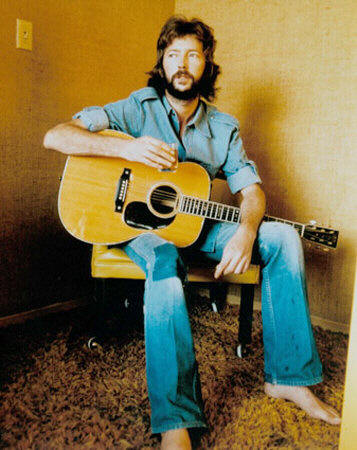
(Who do you think wrote that? Eric Clapton.) If you’ve ever known an addict, it becomes clear that they are dealing with something much greater than just the individual, poor choices that they make. But what we can see so easily to be true in the addict, we may not see as easily to be truth about ourselves. We are in precisely the same situation. (This is Paul’s point.) We are all under the Power of Sin and we cannot help ourselves. There is no distinction between the addict and the teetotaler. By the time we reach chapter 3 of Romans, Paul intends us all to be on our knees before God -- on our knees with Eric Clapton.
But now . . .
This brings us right up to the beginning of today’s reading, chapter 3, verse 21. (You see my problem today is that we really appreciate this passage in chapter three if we haven’t really taken in chapters 1 and 2.) Martin Luther claimed that this paragraph was ‘the chief point, and the very central place of the Epistle, and of the whole Bible.’ That’s quite a claim! -- The most important paragraph in the whole Bible. Why would Luther make that claim?
The second of the 12 Steps reads, “We came to believe that a Power greater than ourselves could restore us to sanity.” In the sections leading up to this verse, Paul puts us on our knees and prepares us to hear (or more accurately, to rehear) the Good News of the Gospel. Paul begins . . . NOW . . . (Or, But now . . . .) Which is to say that, “At your place of complete helplessness, God has done something completely new . . . ‘to restore us to sanity.’” Listen to how Eugene Peterson translates this magnificent paragraph (it’s on the insert):
But in our time something new has been added. What Moses and the prophets witnessed to all those years has happened. The God-setting-things-right that we read about has become Jesus-setting-things-right for us. And not only for us, but for everyone who believes in him. For there is no difference between us and them in this. Since we’ve compiled this long and sorry record as sinners (both us and them) and proved that we are utterly incapable of living the glorious lives God wills for us, God did it for us. Out of sheer generosity he put us in right standing with himself. A pure gift. He got us out of the mess we’re in and restored us to where he always wanted us to be. And he did it by means of Jesus Christ.
That’s the gospel! In three verses, that’s the message Paul was committed to preaching. In the next several chapters, he is going to describe in detail how God accomplished this. You know, if you are a Christian, that this gospel has to do with what God did through his Son on the cross. That’s not a surprise. We know that. But we need to be reminded.
We Need to be Reminded
Remember, Paul was writing to Christians, to the church in Rome. Like you and me, they had heard and accepted the Gospel. Still, they needed to be reminded of the firm ground on which they stood.
It would be something like how a husband and wife need, from time to time, to rehearse the story of how they met and fell and love. They need to recall the details. They need to remember that the relationship began as an experience of Grace. (That’s what Love is all about, experiencing Grace from another person.) They need to be reminded of the firm ground on which they stand.
So Deacon Linda and I invite you to read Romans with us this summer. Wouldn’t it be powerful if, as a parish family, we all read this story together. It’s a story of Grace, a story of Love.
A story of how he got us out of the mess we’re in.